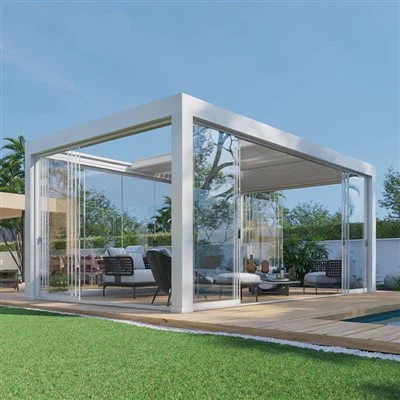

Hey there! I'm a supplier of adjustable louvered pergolas, and today I'm gonna share with you how I test the functionality of a motorized adjustable louvered pergola. It's super important to make sure these things work like a charm before they reach our customers.
First off, let's talk about the motor. The motor is the heart of the motorized adjustable louvered pergola. We start by giving it a visual inspection. Check for any signs of damage, like dents or scratches on the motor housing. You wouldn't believe how often a small physical issue can lead to big problems later on.
Once the visual check is done, it's time to power up the motor. We connect it to a power source and see if it starts running smoothly. There shouldn't be any strange noises like grinding or rattling. A well - functioning motor should run quietly and steadily. If it's making a bunch of noise, there could be something wrong with the internal components, like the gears or the bearings.
We also test the motor's speed and torque. The louvers on the pergola need to open and close at an appropriate speed. Too fast, and it might cause damage to the louvers or the structure. Too slow, and it won't be very practical for users. To test the torque, we simulate different loads on the louvers. For example, we can add a bit of extra weight to mimic harsh weather conditions like strong winds or heavy rain. If the motor can still operate the louvers properly under these simulated loads, it's a good sign.
Next up, the louver movement. We need to make sure the louvers open and close evenly. One of the ways we do this is by using a simple laser alignment tool. This tool helps us see if each louver is moving in sync with the others. If one louver is moving faster or slower than the rest, it can cause uneven shading or even structural problems over time.
We also test the range of motion of the louvers. They should be able to open fully to let in maximum sunlight and close completely to provide protection from the elements. Sometimes, the louvers may get stuck at certain angles. To fix this, we check the tracks that the louvers slide on. There could be debris or misalignments in the tracks that prevent smooth movement. We clean the tracks and make any necessary adjustments to ensure the louvers can move freely throughout their entire range of motion.
Another important aspect is the control system. Most motorized adjustable louvered pergolas come with a remote control or a smart - control system. We test the responsiveness of these controls. When we press a button on the remote, the louvers should start moving right away. If there's a delay, it could be a problem with the signal transmission.
We also check the different modes and functions available on the control system. For example, some pergolas have a timer function that allows users to set the louvers to open or close at specific times. We test this function by setting a timer and seeing if the louvers operate as expected. And if there are any preset positions, like "half - open" or "storm mode," we make sure they work correctly.


Now, let's talk about the weather resistance. Since these pergolas are designed for outdoor use, they need to be able to withstand various weather conditions. We set up our testing area to simulate different weather scenarios. To test for rain resistance, we use a water shower system. We spray water on the pergola at different angles and intensities to see if any water leaks through when the louvers are closed.
For wind resistance, we use a large fan to create different wind speeds. The pergola should be able to stay stable and the louvers should remain in place. If the wind causes the louvers to flutter or the structure to shake too much, it might not be suitable for areas with high winds.
We also test the durability of the materials. The frame of the pergola is usually made of a strong material like aluminum. We perform scratch and corrosion tests on the frame. For the scratch test, we use a standardized tool to apply a certain amount of pressure and see if the surface gets damaged. For the corrosion test, we expose the frame to a corrosive environment, like a salt - water spray, for a period of time. If there are any signs of rust or degradation, it means the material may not be of high enough quality.
When it comes to the additional features, like the LED lights and side screens. In the case of LED lights on an Outdoor Pergola With LED Lights And Side Screens, we check if they are working properly. We turn on the lights and make sure they are bright enough and free of any flickering. For the side screens, we test their ability to roll up and down smoothly. The screen material should also be strong enough to block out insects and wind.
Now, you might be wondering about some of the different types of pergolas we offer. For example, we have the Aluminum Alloy Telescopic Gazebo. This type of pergola is great for those who want a flexible outdoor space. When testing it, we pay special attention to the telescopic mechanism. The parts should slide in and out easily without getting stuck.
Then, there's the Pergola With Glass Walls. The glass needs to be firmly attached to the frame. We check for any cracks or chips in the glass, and also test its insulation properties. A good quality glass will help keep the inside of the pergola at a comfortable temperature.
Our Advanced Motorized Pergola Foof features some high - tech functions. We dive deep into its smart - control features, such as connecting it to a mobile app. We test the stability of the connection and the accuracy of the commands sent through the app.
And the Outdoor Garden Telescopic Pergola is designed for garden settings. We focus on its overall aesthetics and how well it blends in with the outdoor environment. Of course, we still perform all the basic functionality tests to make sure it meets our quality standards.
In conclusion, testing the functionality of a motorized adjustable louvered pergola is a comprehensive process. It involves checking the motor, the louver movement, the control system, the weather resistance, and all the additional features. By doing these tests, we can ensure that our customers get a high - quality product that will last for years.
If you're interested in our adjustable louvered pergolas or have any questions about the testing process, feel free to reach out. We'd be more than happy to discuss your specific needs and help you find the perfect pergola for your outdoor space.
References
- "Handbook of Outdoor Structure Testing"
- "Guide to Motorized Systems in Outdoor Furniture"